
Slab leak water damage in League City, TX
The under-slab leak you might smell before you see, and why two different companies handle it.
Call For Help(281) 903-551424/7 emergency line. Free estimates from local pros.
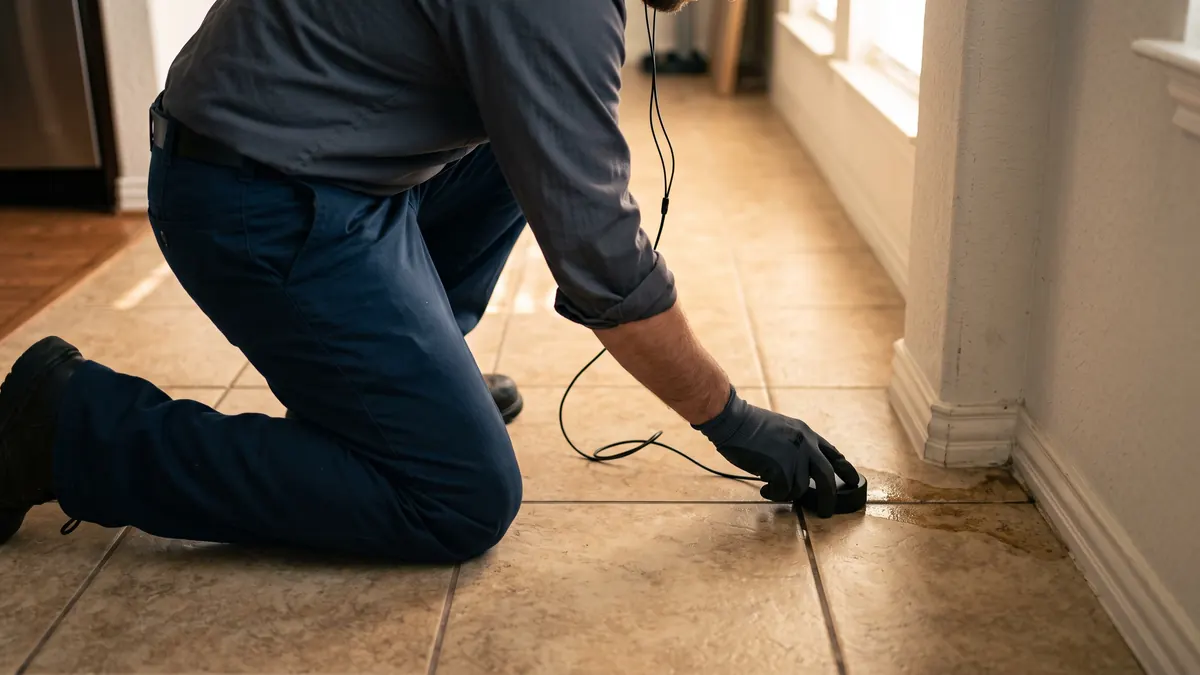
A slab leak is a water or drain line that has failed beneath the concrete your house sits on, and it often shows up as a smell or a warm patch on the floor before it ever shows up as a puddle. No single company fixes all of it. The pipe belongs to a plumber or a leak-detection specialist. The water damage it leaves behind is the half we take calls for. Tell us what’s going on, and we’ll line up local help on the damage side while the pipe gets handled separately.
Two calls, not one
Plumbers and leak-detection specialists find and stop the actual leak. Restoration crews deal with everything the water touched on its way out, the flooring, the drywall, and moisture that traveled sideways under a wall before it ever surfaced. Skip either call and half the problem stays standing. After the pipe is repaired and everything reads dry, water damage repair picks up from there: what gets cut out, what gets matched, and what a fair scope looks like.
The clues cluster before the puddle does
A slab leak rarely shows up as one obvious sign. Watch for a patch of floor that runs warmer or damper than the tile around it, a water bill that jumps with nothing at the house to explain it, and a faint hissing or running sound in an otherwise quiet room. Any single one of these could be something else, a space heater, seasonal use, an icemaker cycling. Two of them together, especially the bill and the warm spot, are worth acting on instead of waiting for a third to show up.
Why detection doesn’t start with a jackhammer
Finding a slab leak is a pinpointing job before it’s ever a digging job. Leak-detection specialists narrow down the location with equipment built for exactly this, so the plumber knows where to open the slab instead of guessing across the whole floor. The slab leak signs guide settles which tool typically comes first and what each one is actually listening or looking for.
League City’s plumbing story splits by decade
League City stayed a small town for a long time. It counted about 2,622 residents in 1960 and hadn’t yet reached 17,000 by 1980. Nearly all its growth came after that, climbing from roughly 30,000 residents in 1990 to 114,392 by 2020. That timeline matters underground, because copper supply lines were standard through the 1960s and 70s, and PEX became the norm as the city kept building. Most of League City’s housing stock sits on the newer, PEX side of that line, while older pockets built in the 1970s and 80s are the homes more likely to still run copper.
Why adjusters treat a slab leak differently
A slab leak can run for weeks before anyone notices it, and that gap changes how an insurer looks at the claim. Sudden, obvious failures, like a pipe that bursts outright, usually read as accidental damage a standard policy expects to cover. A slab leak that seeped slowly under the floor for an unknown stretch of time can get treated more like a gradual, maintenance-related loss, and many policies handle that differently. The insurance claim guide narrows down what documentation helps make that case once a claim is open.
The slab tells on itself
A slab leak doesn’t stay hidden forever. It leaves clues on the floor, on the water bill, and sometimes in the quiet of a closed-up room, well before it turns into an emergency. Catch two of those clues at once and treat that as your cue to call both a leak specialist and a restoration crew, rather than waiting for a puddle to make the decision for you.
Common questions
Will my policy pay for a slab leak?
It depends on your policy and how long the leak ran before anyone found it. Some policies cover the sudden failure but treat the slower, hidden part of the loss differently, since a leak that sat for weeks can read as gradual damage. Check your policy or ask your adjuster for specifics before assuming either way.
Does fixing a slab leak always mean breaking up the floor?
Not always. Some repairs tunnel underneath the slab from outside the house, avoiding the floor altogether. Others reroute the line through the attic or walls instead of chasing the original path. Which option makes sense depends on where the leak sits and what the plumber or leak-detection company recommends.
How does a specialist pinpoint a leak before any digging starts?
Leak-detection specialists use equipment built to trace water and sound through concrete, narrowing the search to a small area before anyone opens the slab. That narrows the digging down to a confirmed spot instead of guesswork across the whole floor.
Which company should I call first, the plumber or the water damage line?
Either call is a fine place to start, since the two jobs run more in parallel than in sequence. If you're not sure who to reach first, call us and we can help sort out next steps on the water damage side while you line up the leak repair.
Related pages
Appliance Leak Cleanup
Water heaters, washer hoses, and dishwasher lines all age out eventually, and none of them give much warning when they finally fail.
Learn more →Burst Pipe Cleanup
What to shut off first, why League City's 2021 freeze still matters, and what happens once the water's off.
Learn more →Ceiling Water Damage
Roof leaks, AC overflow, and upstairs plumbing all leave the same kind of ceiling stain, so telling them apart matters before anyone starts cutting.
Learn more →Commercial Water Damage
A flooded office or storeroom isn't a bigger version of a home loss. It's a different problem, measured in days closed, not gallons.
Learn more →Talk to a local pro now
We answer 24/7. One call gets a League City crew moving on your water damage, with a free estimate and help with your insurance claim.
Call For Help(281) 903-5514Free estimates. No obligation to hire.